
What Actually Happens in a Private Tantra Session
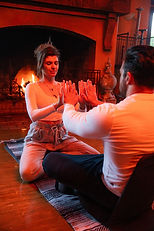
Most people who book a private session with us have been thinking about it for months.
They've read the page. Closed the tab. Opened it again a few weeks later. Somewhere in that loop is a question they can't quite bring themselves to type into a search bar, let alone say out loud on a discovery call.
So let's answer it directly, along with everything else you're wondering.
The question you're actually asking
You want to know whether this is sexual.
The answer is no. A private session with us is fully clothed. There is no nudity, no sexual contact, and no sexual activity of any kind. That's not a policy we bend for the right client or the right circumstance. It's the floor the entire practice stands on.
Tantra in the West got tangled up with something it isn't. The tradition we work from, rooted in classical Kashmir Shaivism, is a body of practice about presence, embodiment and the nature of awareness. Sexuality is one domain it touches, the way it touches grief, anger, creativity and death. It is not the point.
What we teach is how to be in your body without leaving. That skill transfers into intimacy, and for a lot of our clients that's what brings them in. But the room itself is a working room, not a bedroom.
Before you ever get in the room
Every private session starts with a discovery call. Thirty minutes, free, and no pressure at the end of it.
That call is mutual assessment. You're deciding whether you trust us. We're deciding whether this work is right for you, and whether right now is the right time.
Sometimes it isn't. If someone is in acute crisis, in the early aftermath of severe trauma, or actively unsafe, we'll say so and point them toward a licensed therapist instead. We're coaches and practitioners, not clinicians, and we don't treat mental illness. Knowing where our work ends is part of doing it well.
If we go ahead, we'll ask about your history, your nervous system, what you've already tried, what you're hoping for and what you're afraid of. That last one matters more than people expect.
The first twenty minutes
You arrive. You take your shoes off. You sit down.
Then we talk, usually longer than you'd expect. Not therapy talk, and not a recap of your childhood. We're tracking something more immediate: what's happening in you right now, in this room, having just walked in.
Your breath is probably high in your chest. Your jaw might be set. You may notice you're explaining yourself quickly, or filling silence, or sitting very still.
None of that is a problem to fix. It's information. It's your nervous system doing what it learned to do in rooms it wasn't sure about. We name it out loud, gently, and that naming is already the beginning of the work.
Consent gets established here, explicitly, before anything else happens. What you're up for. What you're not. You can stop at any moment, for any reason or no reason, and stopping will be met with zero disappointment from us. We'd rather you stop ten times than override yourself once.
The body of the session
From there it varies, because you vary. But most sessions move through some combination of breath, movement, sound, stillness, and direct attention to sensation.
We might slow your breathing down until the thinking quiets and something underneath it becomes available. We might have you stand and let your body move the way it wants to, which is uncomfortable for about ninety seconds and then frequently becomes the most honest thing that's happened to you in years. We might ask you to make sound, because the throat is where a lot of people store what they never said.
We might do almost nothing at all. Some of the most significant sessions we've held have been two people sitting quietly while someone finally lets themselves feel something they've been outrunning since they were nine.
Throughout, we're asking a version of the same question: where are you feeling that? Not what do you think about it. Where does it live.
Your nervous system stores what your mind has already processed and filed away. Bessel van der Kolk's research made this mainstream, and Stephen Porges' polyvagal work gave us the map of how the body moves between activation, shutdown and genuine safety. What we do is the applied version of that. You learn to notice which state you're in, and eventually to influence it.
On touch
Some sessions include touch. Many don't.
When it happens it is non-sexual, over clothing, and negotiated out loud beforehand: what kind, where, for how long, and how you'll signal to stop. Usually it's a hand on the upper back or the shoulders, offering the nervous system a reference point for support.
If touch isn't something you want, say so on the discovery call. You will not be talked into it, and the session loses nothing.
What if I cry, freeze, or feel nothing at all
All three happen. All three are fine.
Crying is common and doesn't require an explanation. You don't have to narrate it or apologize for it. We'll stay with you.
Freezing is also common, especially for people with trauma history. The body decides that stillness is safer than engagement. If you go quiet and far away, we'll notice, slow everything down, and bring you back through something concrete: your feet on the floor, the temperature of the air, the sound of your own breath. We won't push through a freeze. Pushing through is how people get hurt.
Feeling nothing is the one people are most embarrassed about, and the most misunderstood. Numbness isn't failure. It's a protection that worked, often for decades. It doesn't dissolve because you booked a session. Getting underneath it takes time, and the first session may mostly be your system deciding whether we're safe enough to bother.
What we don't do
Being specific here is more useful than reassurance.
We don't diagnose or treat mental health conditions
We don't do sexual contact, nudity, or anything framed as sexual
We don't require you to disclose your history in detail
We don't push catharsis or chase a big emotional release
We don't record sessions, and what you say stays between us
We don't work with anyone who's been drinking or using before a session
That last one surprises people. Substances make consent unreliable and disconnect you from the exact signals we're working with.
Afterwards
Sessions run ninety minutes. The last ten are for coming back.
You don't want to walk out of deep somatic work and straight into traffic. We'll slow things down, get you oriented, drink some water, and talk about what to expect over the next few days.
Integration is the part nobody warns you about. It's common to feel unusually tired that evening, unusually emotional the next day, or unusually clear about something you've been avoiding for a year. Occasionally all three. We'll give you one or two small practices to take home, and check in afterwards.
How to know whether you're ready
You're probably ready if you've done real work already, cognitively understand your patterns, and keep running into the same wall anyway. That gap between knowing and changing is where this work operates.
You're probably ready if your body has started making itself heard through tension, exhaustion, or a flatness where aliveness used to be.
You may not be ready if you're in acute crisis, if you're hoping someone will do the work for you, or if you want to understand this rather than feel it. There's no judgment in any of that. Timing is real.
And if you've read this far while telling yourself you're just curious, that's worth noticing too.
Where to start
The discovery call costs nothing and commits you to nothing. Thirty minutes, an honest conversation, and a clear answer about whether this is right for you.
We're based in Boulder and work with clients across Denver and the Front Range, in person and online.
If you'd rather start in a group before doing anything one to one, that's a legitimate on-ramp. Deeper Tantra Level 1 is a two-day workshop, and the Couples Immersion is built for partners doing this together.
Ben and Larinda are the founders of Authentic Essence, offering tantra, embodiment and relationship work in Boulder and Denver, Colorado, and internationally.

Comments